
Positioning Is a Strategic and Financial Decision, Not a Creative One
Positioning is not wording or visual identity. It is the decision about who you serve and who you refuse, and it shows up directly in price, margin and customer acquisition cost. A practical guide with three documented cases and a four-test governance framework.
Positioning is the decision about which category you compete in, what distinguishes you inside it, and who you decline to serve. Its effect is not only perceptual: strong positioning widens the price range a business can defend, lowers customer acquisition cost, and improves retention and lifetime value. Weak positioning pushes competition toward price, and margins erode quietly without the cause appearing in any report.
This article treats positioning as a commercial decision measured by its financial effect, not as a creative output judged by how it looks. It includes three cases documented from primary sources and a governance framework a business can apply internally.
What Positioning Actually Is
Positioning is the act of designing a company’s offer and image so that it occupies a distinct and valued place in the mind of a defined segment, relative to competitors in the same category.
Real value appears when two conditions hold together: the customer recalls your brand as a specific option when thinking about the category, and knows why they prefer you over the alternatives.
The absence of the second condition is the more common failure, and the harder one to detect. Many businesses are known in their market — a customer can name them instantly when the category comes up — yet nobody can state the reason to choose them over anyone else. Such a business believes it is in good shape because awareness is high, when in fact it holds no defensible position at all.
When that reason is missing, competition slides toward price automatically. The logic is simple: the buyer must choose between alternatives that look equivalent, so they look for a single variable they can compare objectively — and price is the only one available. Sliding into price competition is not a choice a business makes. It is the automatic consequence of having no reason for preference.
Strategic Positioning: From Perception to a System of Activities
In his reference article “What Is Strategy?”, published in Harvard Business Review in the November–December 1996 issue, Michael Porter separates operational effectiveness from strategic positioning.
Operational effectiveness means performing the same activities competitors perform, but better: faster, cheaper, or at higher quality. It is necessary, but imitable by nature — what you can learn, your competitor can learn.
Strategic positioning means performing different activities, or performing similar activities in different ways. That is what creates an advantage difficult to copy, because copying it requires a competitor to dismantle their entire activity system rather than improve one part of it.
The distinction is practical, not academic: operational effectiveness makes you faster in the same race; strategic positioning puts you in a different race.
In the same article, Porter sets out three bases on which positioning rests:
- Variety-based positioning — focusing on a particular set of products or services rather than a customer segment, where the business can produce them using a distinctive set of activities.
- Needs-based positioning — closer to traditional thinking about targeting a segment, arising where a group of customers has different needs that a tailored set of activities can serve best.
- Access-based positioning — serving customers who differ in how they can be reached rather than in what they need: geography, scale, or any dimension that calls for a different configuration of activities.
This distinction is practically useful because it prevents a common error: assuming positioning is always a choice of customer segment. Sometimes it is a choice of service scope, and sometimes a choice of route to market.
The Competitive-Role Question
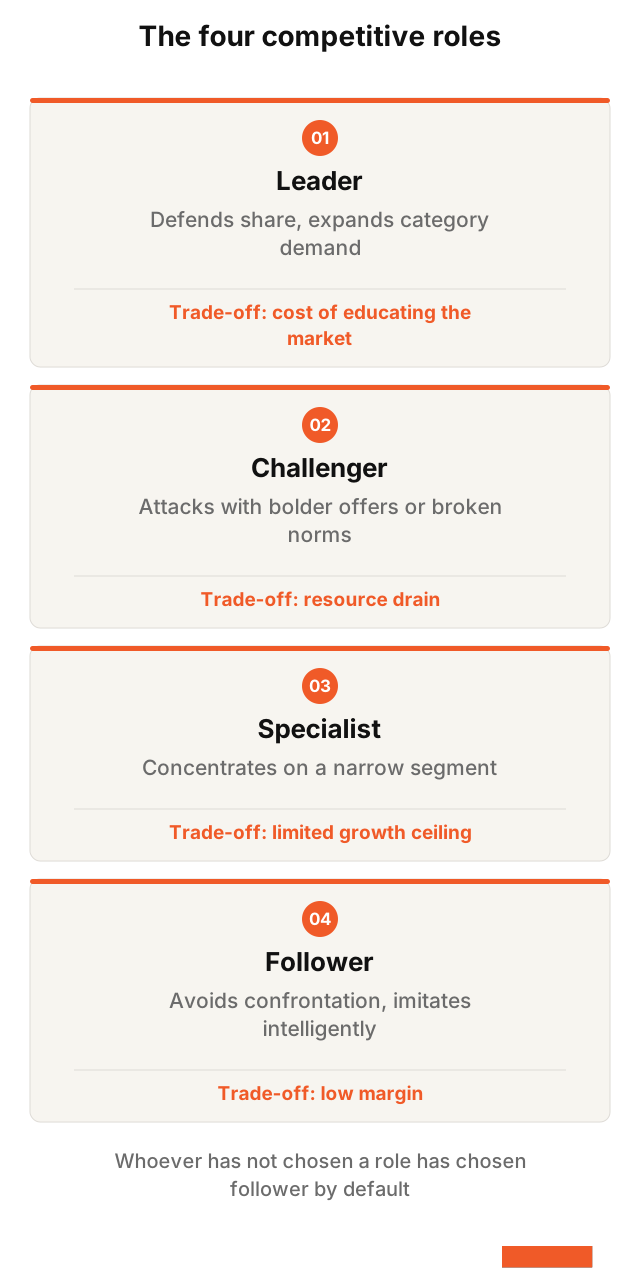
At this level the competitive-role question appears, and it has four answers:
| Role | Competitive behaviour | Principal trade-off |
|---|---|---|
| Leader | Defends share and expands total category demand | High cost of educating the market |
| Challenger | Attacks for share through bolder offers or by breaking category norms | Resource drain in direct confrontation |
| Specialist | Concentrates on a narrow segment with highly adapted service | Growth ceiling set by segment size |
| Follower | Avoids direct confrontation and focuses on intelligent imitation | Low margin and weak pricing power |
The leader carries a burden nobody else does: educating the market. When you are first in a category, you spend explaining the category itself before explaining your offer, and competitors benefit from that spending for free. In return, the leader earns a reference position against which others are measured.
The challenger chooses confrontation deliberately and needs resources that can absorb attrition. Its greatest danger is attacking with the leader’s own tools — it loses, because the leader has more scale to sustain a long war. The successful challenger breaks a category norm the leader cannot match without abandoning its own position.
The specialist achieves the highest relative margin, because depth in a narrow segment is hard to imitate. Its only constraint is that its growth ceiling is the segment size — so expansion means either occupying an adjacent segment or giving up the specialism.
The follower is the only role rarely chosen consciously. Businesses arrive at it by not resolving the earlier questions, and find themselves imitating and discounting. A business that has not consciously chosen its role has implicitly chosen the follower role.
The One-Sentence Test
Any strong positioning answers three questions clearly:
- Which category do we compete in?
- What distinguishes us inside that category?
- What is the minimum set of points of parity that make us a legitimate option in it?
The third question is widely neglected, even though it is a precondition for the first two. Differentiation alone is not enough — you must first be accepted into the category before you can stand out within it. A business that differs on everything is excluded from the consideration set entirely, because the buyer does not classify it among the alternatives being compared.
A practical example: a consultancy with no track record may be technically better than its competitors, but a track record is a mandatory point of parity in its category. Until it meets the minimum points of parity, its differentiation reaches nobody — because it never enters the comparison in the first place.
A simple test reveals positioning strength:
“This brand is my first choice when I want… because it…”
If the customer hesitates to complete that sentence, the positioning is weak no matter how convincing it looked in internal presentations.
The decisive version of this test is run on existing customers, not on your own team. The team knows the answer because it wrote it; the customer knows it only if it actually reached them. The gap between the two answers is the distance between the written positioning and the real one.
The Causal Chain: How Positioning Becomes a Number
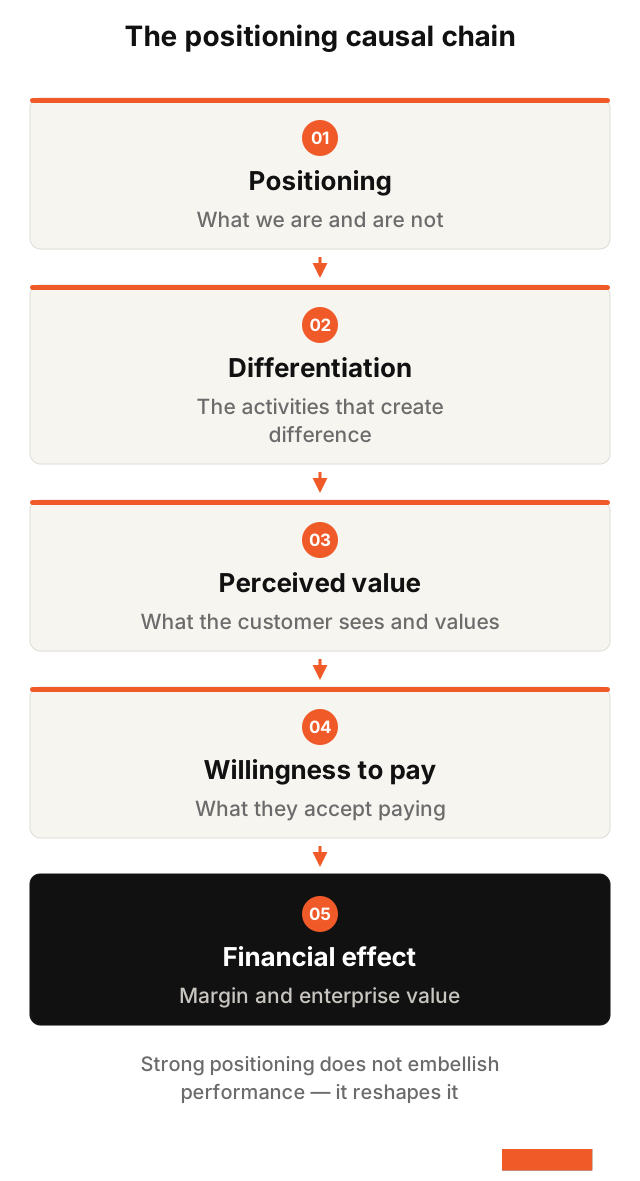
The best way to understand positioning’s effect is to read it as a connected causal chain:
Positioning shapes differentiation. The decision about what you are and are not determines which activities you invest in and which you leave, and those activities are the source of real difference.
Differentiation shapes perceived value. What the customer sees as different is what they value. A difference that is not perceived has no commercial value, however real it is.
Perceived value drives willingness to pay. The customer pays for what they believe they are getting, not for what it costs you to produce.
Willingness to pay flows into margins, growth quality and enterprise value. Here the chain ends at a number that appears in the financial statements.
The practical benefit of reading it this way is that it locates the fault. When the financial result weakens, the question is not “how do we raise prices?” but “which link broke?” — is differentiation absent, present but unperceived, or perceived but irrelevant to what the customer cares about? Each diagnosis leads to a completely different remedy, and treating the wrong link consumes resources without moving the result.
The Financial Effect: Four Mechanisms
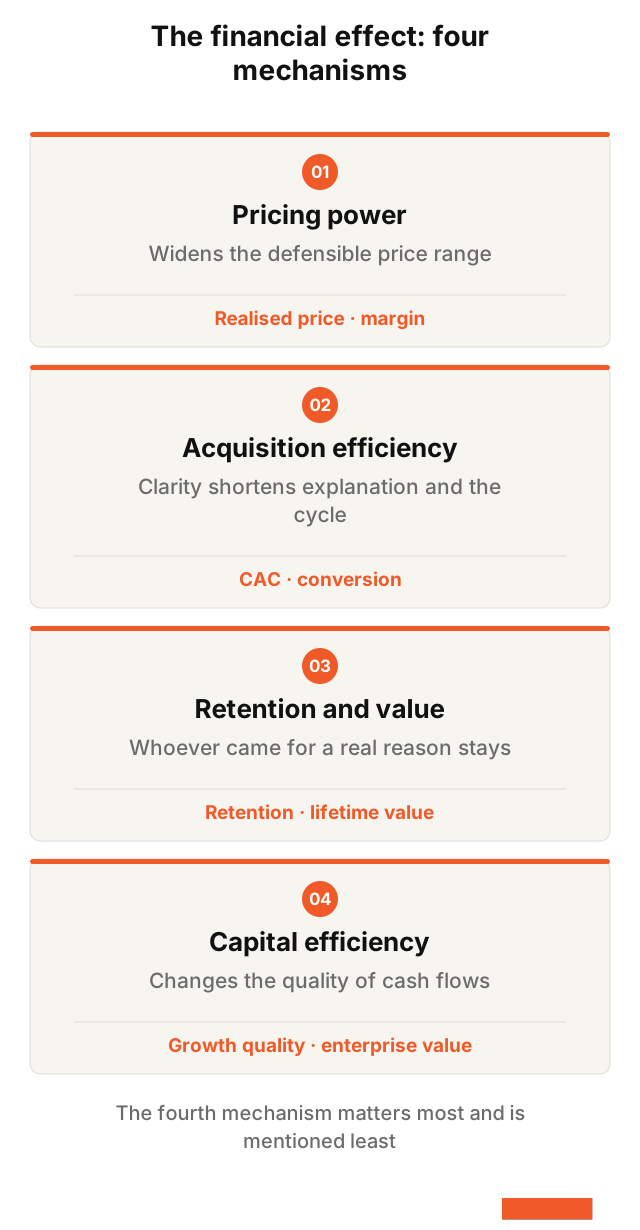
| Mechanism | How it works | Metric that moves |
|---|---|---|
| Pricing power | A distinctive, credibly supported offer widens the defensible price range | Realised price, discount depth, gross margin |
| Acquisition efficiency | A clear position lets the right customer grasp quickly what you offer and why you merit selection | Customer acquisition cost, sales-cycle length, conversion rate |
| Retention and lifetime value | Attracting the right customer for a real reason reduces churn and extends the relationship | Retention rate, lifetime value, LTV-to-CAC ratio |
| Capital efficiency | Improvement across the first three changes the quality of cash flows, not only their size | Growth quality, enterprise value |
Pricing power does not mean the ability to raise prices. It means the width of the range you can defend. A business with strong positioning faces less pressure to discount, because the buyer sees what they lose by choosing cheaper. The revealing metric here is not the list price but the realised price after discounts — and the gap between the two is the most precise available measure of your position’s strength.
Acquisition efficiency improves for a direct reason: clarity shortens explanation. The right customer quickly understands what you offer and why it concerns them, so the sales cycle shortens, conversion rises and acquisition cost falls. The double effect is that clear positioning repels the wrong customer early — a real saving, because opportunities that are worked and then lost cost far more than opportunities never opened.
Retention and lifetime value improve because a customer who came for a real reason stays as long as the reason holds. A customer who came for a discount leaves at the first better discount. Positioning determines not only who buys, but who stays.
Capital efficiency is the mechanism that matters most and is mentioned least. When all three improve together, the result is not larger growth but growth of a different kind: revenue that is more predictable, less dependent on discounting, and cheaper to retain. These qualities are precisely what any acquirer or investor assesses when valuing a business. Positioning does not merely improve operating performance — it reshapes the quality of the cash flows on which value is built.
The Hidden Costs of Weak Positioning
Weak positioning does not only hurt sales. It triggers a chain of economic costs rarely attributed to their real source:
-
Discount warfare. When a business cannot articulate its value, it is forced to compete on price, and price becomes the dominant factor in the purchase decision. Worse, discounting becomes an institutional habit: the customer who received a discount expects it at renewal, and the team that won with a discount opens with one next time. Discounting migrates from an exceptional tool to an implicit policy nobody ever approved.
-
Rising acquisition cost. When the market does not clearly understand why it should choose you, the need for explanation grows, sales cycles lengthen and conversion efficiency falls. The cost here is not only marketing spend but your commercial team’s time, consumed on opportunities that were never qualified — a resource that appears under no budget line.
-
Operational complexity. The absence of clear boundaries around what the business should serve and what it should exclude produces an uncoordinated system of activities. The business accepts work outside its scope, builds scattered capabilities that do not compound, hires mismatched people who do not complement each other, and runs operations that bear no resemblance to one another. This is a real administrative cost that appears in no accounting line.
-
Deteriorating revenue quality. If the customer buys because of the discount rather than the value, revenue becomes less defensible and more expensive to retain. The revenue figure itself looks healthy in the report — it may even be growing — but its quality has deteriorated. That difference surfaces only at the first competitive squeeze, or the first serious attempt to value the business.
These costs never appear in a single report, which is why they are hard to trace. Management sees margin pressure and attributes it to “aggressive competition”, while the root cause is a positioning decision that was never made.
Three Documented Cases
Volvo: One Attribute, Backed by Decisions
Volvo built its position around one clear attribute: safety. What set it apart is that it defended that attribute through decisions that cost money, not through statements.
In 1959, Volvo engineer Nils Bohlin perfected the modern three-point safety belt, and the company made the patent available free of charge to anyone who wished to use it. Volvo Group’s official heritage record credits the invention with saving more than one million lives. The first car fitted with the belt as standard equipment — a PV544 — was delivered on 13 August 1959.
The company did not stop at the invention. In 1967, Bohlin presented a study on Volvo’s behalf at the Stapp Car Crash Conference, “A Statistical Analysis of 28,000 Accidents”, which contributed to United States regulators requiring manufacturers to fit three-point belts in front seats.
The commercial lesson: releasing the patent was a direct, measurable financial concession — the company forwent licensing revenue that would have run for decades. In return it established safety as Volvo’s intellectual property in the market’s mind, converting a technical feature into an identity no competitor could claim by announcement alone.
The rule that follows: positioning that is paid for is believed; positioning that is only announced is not. And the market distinguishes between the two with more precision than any marketing department expects.
New Coke: Testing the Product, Ignoring the Position
In the mid-1980s, Coca-Cola faced mounting competitive pressure from Pepsi and decided to change the formula of its original drink, based on blind taste tests covering roughly 200,000 consumers that showed a clear preference for the sweeter new version.
The methodology was sound by its own standards: a large sample, randomised, with no names or logos to influence judgment. The change was announced on 23 April 1985 — the first formula change in 99 years.
But the market was not buying taste alone. It was buying a daily habit, a memory, and a symbolic attachment accumulated over a century. The rejection was emotional and widespread: letters, phone calls, organised protest groups, and hoarding of the old version.
On 11 July of the same year the company returned the original formula as “Coca-Cola classic”, after just 79 days. The company’s own historical record describes that period as having transformed the soft-drink industry and the company itself.
The commercial lesson: the error was not in the research but in the question asked. Testing a product in isolation from its position measures momentary preference, not a purchase decision. Coca-Cola tested the liquid; the market was buying the meaning.
The rule that follows: when your positioning rests on a non-functional asset — history, belonging, or accumulated trust — testing function alone gives you perfectly valid data about entirely the wrong question.
Salesforce: Redefining the Category
Salesforce was founded in 1999 with a position set against the prevailing model, captured in two words: “No Software”. No on-premise servers, no complex licensing, no long implementation projects — a subscription cloud service instead.
Its strength was not in offering a better CRM than what existed. It was in redefining what the category itself meant. This is a rare kind of positioning: instead of competing for a place inside an existing category, you create a new one in which you are the reference.
The result, more than two decades on: research firm IDC ranked Salesforce the world’s number-one CRM provider for the 13th consecutive year, with a 20.0% market share in 2025, according to its Worldwide Semiannual Software Tracker.
And here is a detail that deserves more attention than the figure itself. Salesforce’s share has been declining steadily for years:
| Year | CRM category market share |
|---|---|
| 2021 | 23.8% |
| 2022 | 22.9% |
| 2023 | 22.1% |
| 2024 | 20.7% |
| 2025 | 20.0% |
Yet it remains in first place by a margin exceeding four times its nearest competitor. The explanation is not that Salesforce is shrinking — its category revenue continues to grow — but that the category it created is expanding faster than it is, drawing in new entrants who take small slices of a larger market.
The commercial lesson: positioning that redefines a category grants long leadership, but not immunity. The category you create attracts new entrants precisely because it succeeded.
The rule that follows: leadership requires continuous defence, not a single declaration. The most dangerous moment for a leader is when it treats its position as a settled fact rather than as ground to be defended each year.
Applying the Framework in B2B Markets
The cases above come from consumer or broad software markets. B2B markets differ in three ways that change how positioning is applied:
The buyer is not a person but a committee. The decision passes through multiple parties, each with a different criterion — the technical evaluator assesses capability, the finance function assesses cost, the operational owner assesses risk. Positioning that addresses one party loses the deal at the others. Good B2B positioning carries three consistent answers, not one answer repeated.
The sales cycle is long and memory is short. Months pass between first contact and contract, during which people, priorities and budgets change. Positioning that is not re-established at each stage erodes — not because it is weak, but because whoever heard it at the beginning may not be present at the final decision.
Risk precedes value. The B2B buyer loses personally if the choice fails and gains institutionally if it succeeds. That asymmetry makes them assess alternatives first on safety, not on distinctiveness. This makes points of parity weigh more heavily in B2B than in any other market — track record, references, and the ability to keep operating.
The practical conclusion: in B2B, differentiation alone does not win. What wins is differentiation built on a solid base of parity that reassures the committee before it persuades them.
Governance Framework: Four Tests
Positioning that is not governed degrades into a slogan within months. These four tests should be run periodically inside the business:
| Test | Questions |
|---|---|
| Value and differentiation | What distinctive value do we create in the market? Do we present it more clearly than competitors? Is it connected to what the customer actually cares about? What alternative does our offer displace in the customer’s mind? |
| Articulation and execution | Do we have a clear internal articulation of the positioning? Does it direct decisions on product, pricing, messaging and channels? Is it consistent with our capabilities, resources and culture, or does it only look good on paper? |
| Economic effect | Does the positioning translate into a higher price or a lower cost? Does the realised price reflect the stated value? Where does margin leak between discounts and concessions? Does it support growth quality, not just growth volume? |
| Decisiveness and governance | What trade-offs do we accept to protect the positioning? Which customers, channels or opportunities do we deliberately refuse? Who owns the positioning decision inside the business? Does it translate into actual behaviour in the market? |
The fourth test is the hardest and the most revealing, and its most important question is the question of refusal. A business that accepts every opportunity that reaches it has not made a positioning decision — it has made a survival decision.
The clearest rule I know: a business that cannot name a customer it deliberately refused does not have a position. It has marketing copy.
Conclusion
Positioning is a strategic decision because it governs competitive choice, value logic and activity design. It is a financial decision because it determines willingness to pay, acquisition efficiency, retention depth, margins and enterprise value.
Weak positioning therefore produces more than a faint brand image. It produces continuous economic drain whose source is difficult to trace because it is spread across unrelated line items. Strong positioning, by contrast, creates a defensive advantage that protects both the competitive position and the financial results.
Strong positioning does not embellish performance — it reshapes it.
Sources
All links below were accessed on 17 September 2026.
Primary sources
Volvo Group — “The three points that saved one million lives”, official heritage record.
https://www.volvogroup.com/
Documents: the 1959 development of the three-point safety belt, the free release of the patent, and the estimate of more than one million lives saved.
The Coca-Cola Company — “New Coke: The Most Memorable Marketing Blunder Ever?”, official historical record.
https://www.coca-colacompany.com/
Documents: the 23 April 1985 announcement, the return of the original formula on 11 July 1985, and the 79-day period.
Salesforce — “Salesforce Ranked #1 CRM Provider for 13th Consecutive Year”, 4 June 2026.
https://www.salesforce.com/
Documents: 20.0% share in 2025 and the 13th consecutive first-place ranking, based on the IDC Worldwide Semiannual Software Tracker.
Salesforce — IDC CRM market share ranking 2025, 16 May 2025.
https://www.salesforce.com/
Documents: 20.7% share in 2024 and the 12th consecutive first-place ranking.
Harvard Business School — article record in the faculty research listing.
https://www.hbs.edu/
Full bibliographic reference: Porter, M. E. “What Is Strategy?” Harvard Business Review 74, no. 6 (November–December 1996): 61–78.
Secondary sources
Lemelson-MIT — Nils Bohlin profile.
https://lemelson.mit.edu/
Documents: the 1967 Stapp Car Crash Conference study, its influence on United States regulation, and details of Bohlin’s career.
CX Foundation — “Salesforce Extends Its CRM Market Lead”.
https://cxfoundation.com/
Documents: the market-share series from 2021 to 2025 and competitor rankings.
Encyclopaedia Britannica — “April 23: The Not-So-Sweet Backlash to New Coke”.
https://www.britannica.com/
Documents: background on the Pepsi Challenge from 1975 and details of the market reaction.