
Churn Is Not a Post-Sale Problem: The Missing Condition in Retention's Most-Cited Number
The reference study everyone cites on customer retention carries a condition that gets dropped in the retelling. Restoring it inverts the diagnosis: much churn is not a service failure but the result of acquiring a customer who never fit.
The most-cited figure in customer retention — that a five-point increase in retention lifts profits by somewhere between 25% and 95% — comes from a study published in Harvard Business Review in 1990. Its original abstract carries a condition that disappears from almost every retelling: companies should aim to keep every customer they can profitably serve. That last clause is where the whole argument lives. Not every customer is worth retaining, and much churn is not a failure of post-sale service — it is the result of acquiring a customer who never fit.
Recent data supports this directly: the two largest stated causes of buyer regret have nothing to do with post-sale service quality. They occur during the sale and at handover.
The Number and Its Missing Condition
In September 1990, Frederick Reichheld and Earl Sasser published “Zero Defections: Quality Comes to Services” in Harvard Business Review.
The finding became one of the most-quoted statistics in management: cutting the defection rate by five points raises profits — but by amounts that differ sharply across sectors.
| Sector in the original study | Effect of a five-point cut in defections |
|---|---|
| A bank’s branch system | 85% more profit |
| An insurance brokerage | 50% more |
| An auto-service chain | 30% more |
The gap between 30% and 85% is not a detail. It means retention economics are not a universal law but depend on business model, cost structure and relationship length. The number quoted as a universal rule is, at source, a variable range.
And the more important condition
The study’s abstract states the goal in specific terms: companies should aim for zero defections, meaning keeping every customer they can profitably serve.
That condition vanishes in most retellings. The recommendation shifts from “retain those worth retaining” to “retain everyone” — two entirely different instructions leading to opposite decisions.
The first calls for a question about selection. The second calls for a bigger post-sale service budget.
Where Churn Actually Begins
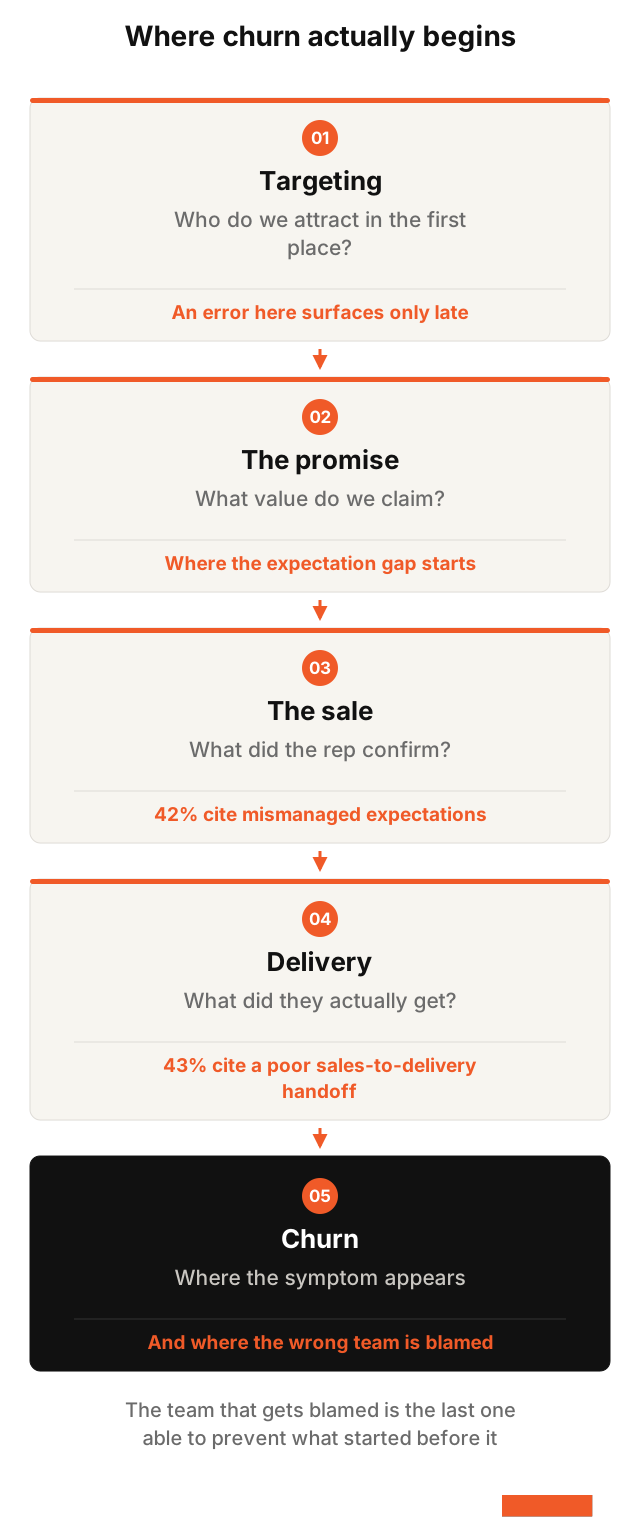
Here the argument becomes testable rather than merely logical.
In a survey by Gartner Digital Markets within its 2024 Tech Trends research, covering 3,484 software buyers worldwide, 60% reported regretting a purchase made in the past 12 to 18 months. More than half of those regretted more than one.
And the result is not merely a feeling: 24% of regretful buyers cancelled their contracts, and 33% moved to a different vendor.
Here is the figure that settles the diagnosis. The two largest vendor-related causes of regret:
| Cause | Share | When it occurs |
|---|---|---|
| A poor handoff between sales and implementation | 43% | At delivery |
| Mismanaged expectations | 42% | During the sale |
Both occur before the post-sale team’s work begins at all.
As for product-related causes, the first is a higher-than-expected total cost at 33%, and the second is slow or difficult implementation at 32%. Both are gaps between what was understood and what materialised — not defects in post-sale service.
And a second study confirms the direction
In a separate Gartner survey conducted between February and March 2023 among 1,503 respondents at organisations with annual revenue above fifty million dollars across Western Europe, North America and Asia-Pacific, 60% of technology buyers involved in renewal and expansion decisions said they regret nearly every purchase they make — a six-point increase on 2020.
The trend is worsening, not improving.
What This Means for Diagnosis
When a customer churns, the usual question is: how do we improve retention? The harder — and usually more correct — question is: why did they buy from us in the first place?
Because the customer may have entered with expectations the product or service was never able to meet. Marketing promised something, sales confirmed the promise, the customer bought on that basis — then discovered that the value they expected differed from the value they received.
The problem here began before the customer became a customer.
This is not a defence of the post-sale team, nor a dismissal of its role. It is a definition of the limits of what it can do: customer success can rescue a struggling relationship; it cannot create a fit that does not exist.
Four Questions Before Blaming the Last Team in the Chain
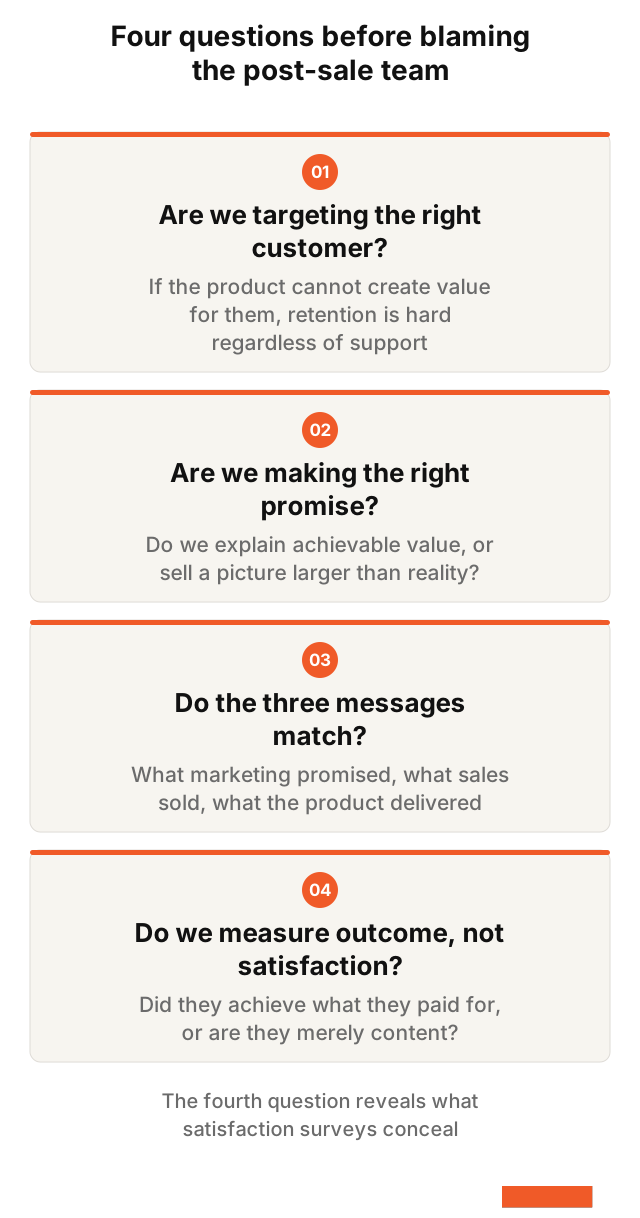
Before holding the post-sale team responsible for churn, four questions locate the fault:
Are we targeting the right customer? Not every prospect is a suitable customer. If your product cannot create real value for them, retention will be hard however strong the service team.
Are we making the right promise? Does marketing explain the value the product can actually deliver, or sell a picture larger than reality? The difference between them is the distance the customer will measure after purchase.
Do the three messages match? If marketing promised one thing, sales sold another, and the product delivered a third, do not expect a stable experience. The 43% figure on poor sales-to-implementation handoff is exactly that misalignment, measured.
Do we measure customer success by outcome? It is not enough that the customer is satisfied or using the product. The question: did they achieve the result they paid for?
The fourth question is the most revealing, because satisfaction is a late and weak indicator. A satisfied customer who achieved no result will look fine in the survey, then not renew. The company reads that as a surprise, when the data was measuring sentiment rather than effect.
Why More Acquisition Spend Multiplies the Problem
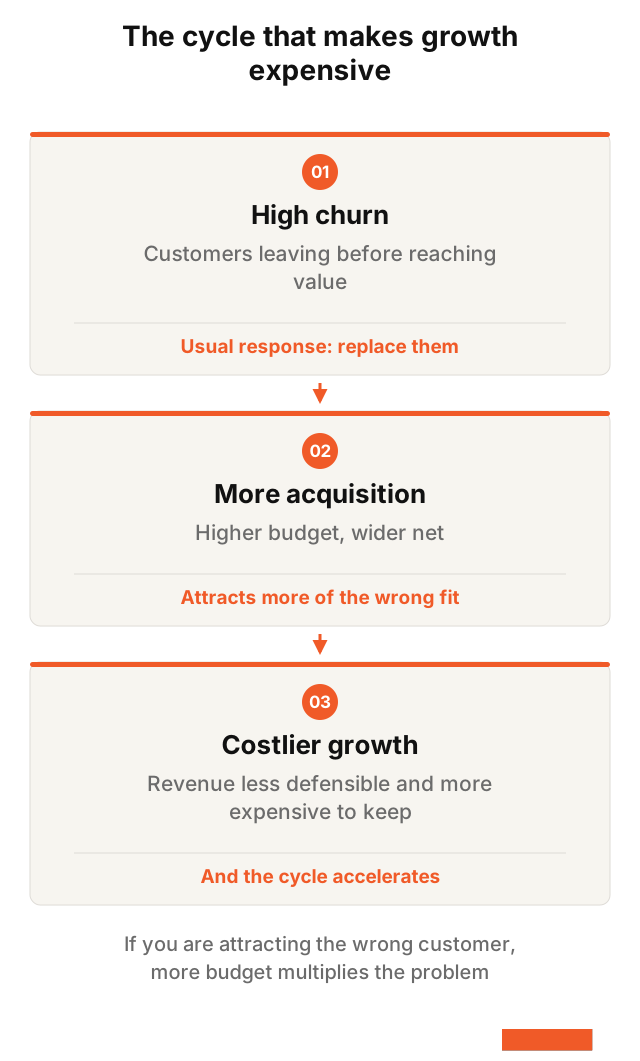
The most common response to churn is to replace it — raising acquisition spend to cover those lost.
That response is correct if the problem is retention. It is destructive if the problem is selection.
Because the channel that attracted the wrong-fit customer will attract more of them when widened. Churn rises, the need to replace grows, the net widens further — a cycle that accelerates each time it is answered the same way.
The cumulative effect is that the revenue itself deteriorates in quality: less predictable, more expensive to keep, more dependent on a continuous flow of new customers. Which is precisely what depresses enterprise value in any serious valuation.
One question separates the two paths:
Are we losing customers because retention is weak? Or because our marketing strategy attracts the wrong customer and creates expectations we cannot meet?
The difference between those answers can mean a large difference in the cost of growth.
How to Answer the Question with Data
The answer does not require intuition. Three analyses suffice:
Segment churned customers by acquisition channel. If one channel produces markedly higher churn, the problem lies in what that channel promises or in the type of customer it attracts — not in service.
Measure churn by relationship age. Early churn — before the customer reaches first value — is a fit signal. Late churn after years of use is a different signal entirely: competition, changed need, or neglect.
Compare churned customers to retained ones against your ideal customer criteria. If those who leave differ structurally from those who stay — in size, sector or use case — you know which segment does not suit your model.
The practical output is a sharper definition of the ideal customer, built on who you retain profitably rather than on who you can persuade to buy.
Conclusion
Strategic marketing does not begin with “how do we attract more customers?” It begins with: who is the customer for whom we can create real value? Positioning, message and offer are then built around that value.
Because the goal is not to sell once, but to attract the right customer, deliver what you promised, and turn that into a relationship and sustainable growth.
And that is the condition Reichheld and Sasser set thirty-six years ago and which was dropped in the retelling: the goal is not zero defections, but keeping every customer you can profitably serve.
Sources
All links below were accessed on 2 October 2026.
The reference study
Frederick Reichheld and Earl Sasser — “Zero Defections: Quality Comes to Services”.
Full bibliographic reference: Reichheld, F. F., and W. E. Sasser Jr. “Zero Defections: Quality Comes to Services.” Harvard Business Review 68, no. 5 (September–October 1990): 105–111.
https://www.bain.com/
Documents: the goal stated as keeping every customer that can be profitably served, and the effect of a five-point cut in defections at amounts differing by sector — 85% in a bank’s branch system, 50% in an insurance brokerage, and 30% in an auto-service chain.
The study’s bibliographic record at Semantic Scholar.
https://www.semanticscholar.org/
Documents: full publication data and the original abstract in its own words.
Published field research
Gartner Digital Markets — “Why Software Buyers Experience Regret”, based on the 2024 Tech Trends Survey of 3,484 software buyers worldwide.
https://www.gartner.com/
Documents: that 96% of buyers start with a vendor list and 89% purchase from it, that 60% regretted a purchase within 12 to 18 months, that 24% of regretful buyers cancelled their contracts and 33% moved to a different vendor, that the two largest vendor-related factors are a poor sales-to-implementation handoff at 43% and mismanaged expectations at 42%, and that the leading product-related causes are higher-than-expected cost at 33% and slow or difficult implementation at 32%.
Gartner — press release: 60% of technology buyers involved in renewal decisions regret nearly every purchase they make, 14 June 2023.
https://www.gartner.com/
Documents: the survey conducted February to March 2023 among 1,503 respondents at organisations with revenue above fifty million dollars across Western Europe, North America and Asia-Pacific, and the six-point rise in regret since 2020.
A note on the circulated figure
The common rendering of the Reichheld and Sasser finding is “25% to 95%”. The range appearing in the academic literature citing the study is 25% to 85%, and the figures given in the study’s own abstract are 85%, 50% and 30% by sector.
This article uses the study’s own figures as its abstract states them, not the circulated rendering — and the difference between the two is a miniature of what this article is about: a number passed on without its condition or its context, becoming a rule nobody ever stated.