
B2B Targeting: Three Answers to One Question
Most businesses do not suffer from having no targeting strategy. They suffer from having three without realising it: the targeting they write, the targeting they fund, and the targeting that actually buys. A practical framework with two documented cases and a one-week test.
Inside any business that sells to other businesses there are three different answers to one question: who do we target? One answer written in the strategy, one revealed by the budget, and one visible in the list of closed deals. When the three diverge, the business is not running one market with three instruments — it is running three businesses at once, on one business’s budget.
This article sets out a framework for diagnosing and closing that gap, with two cases documented from published sources and a practical test that can be run in a single week.
A Three-Minute Test
Before anything else, open three files and place them in front of you in this order:
- The strategy document — the page that answers “who do we serve?”
- The marketing and sales budget for last quarter
- The last thirty closed deals from your CRM
Read them in that order and note whether they answer the same question the same way.
In most cases the answers are three. This is not one company’s problem — it is among the most common strategic gaps in B2B, and among the hardest to detect, because each layer looks entirely reasonable on its own.
The Three Layers of Targeting
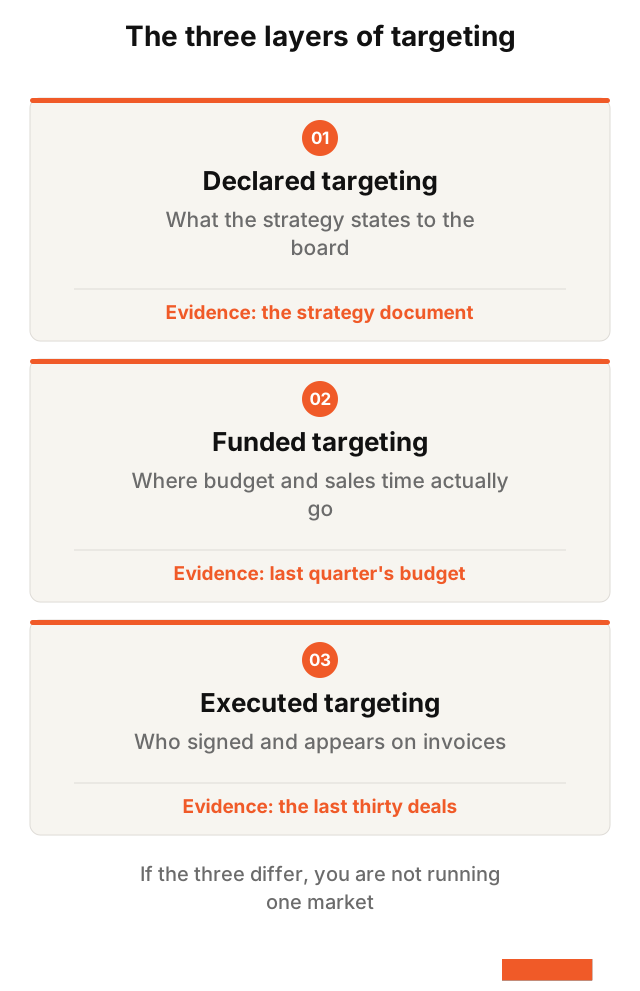
Declared targeting
What the strategy document states, and what is told to the board, to investors, or in company presentations. It is usually clear, logical and convincing — because it was written in calm conditions with enough time to think.
But its clarity does not make it the actual targeting. A written strategy expresses intent, and intent binds nobody by itself.
Funded targeting
Here the truth begins to surface. Where does the budget actually go? Who receives the sales team’s time? Which accounts get the largest share of effort, follow-up and tailoring?
What gets funded always reveals the real priorities, because a budget is a decision that admits no diplomacy: every unit that goes to one place is a unit that did not go to another.
Executed targeting
And here the final truth appears. Who attended the sales meetings? Who signed the contracts? Whose names appear on the invoices?
These are the company’s real market — and not necessarily the market the strategy describes.
Why the layers diverge
Divergence does not happen by decision. It happens by accumulation. An urgent opportunity outside the scope is accepted because the quarter is closing. A large account from another sector is served because refusing it is awkward. A campaign is launched at a segment because its data is available, not because it is a priority.
Each of those decisions is reasonable on its own. Their sum is a completely different targeting from the one that was written.
Three Tiers Inside the Target List
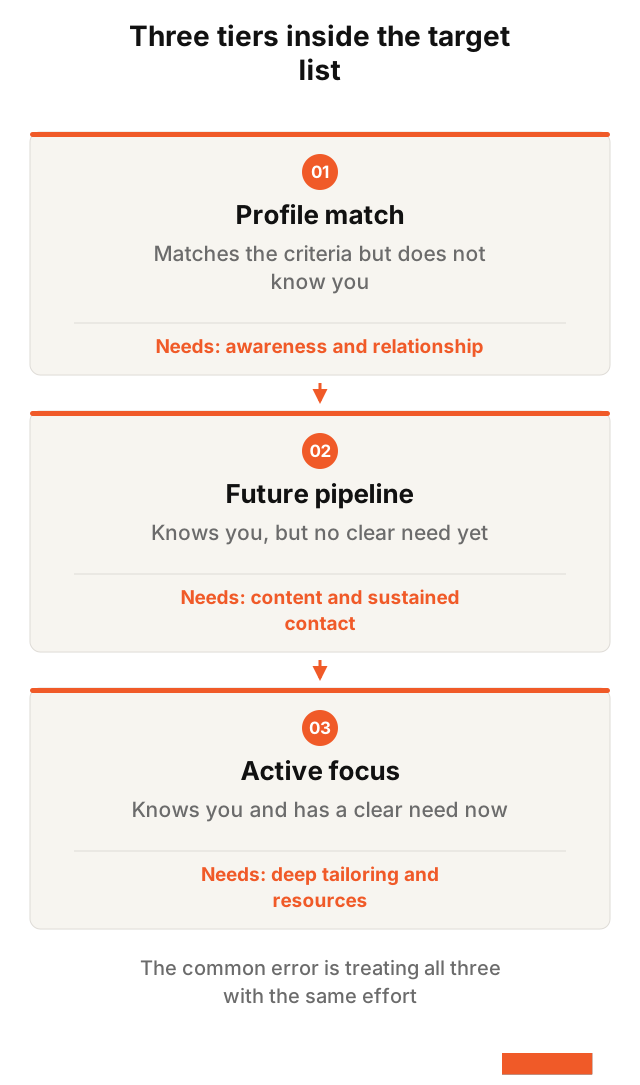
Even within declared targeting itself, not all accounts are equal. There are three fundamentally different tiers:
Profile match. Accounts that meet the ideal customer criteria — size, sector, maturity — but do not know you yet. What this tier needs is awareness and relationship building, not a commercial proposal.
Future pipeline. Accounts that know you or have engaged with you, but whose need has not surfaced clearly. What they need is relevant content and sustained contact that keeps you present until the need matures.
Active focus. Accounts that know you, engage with you, and have a clear need now. These alone warrant deep tailoring and concentrated resources.
The common error is treating all three the same way: the same budget, the same messages, the same follow-up, the same effort.
The result is resources consumed across a large list with no concentration. The business believes it is running a targeting programme, when it is distributing effort evenly across accounts whose conversion odds differ enormously.
Three Lenses for Choosing an Account
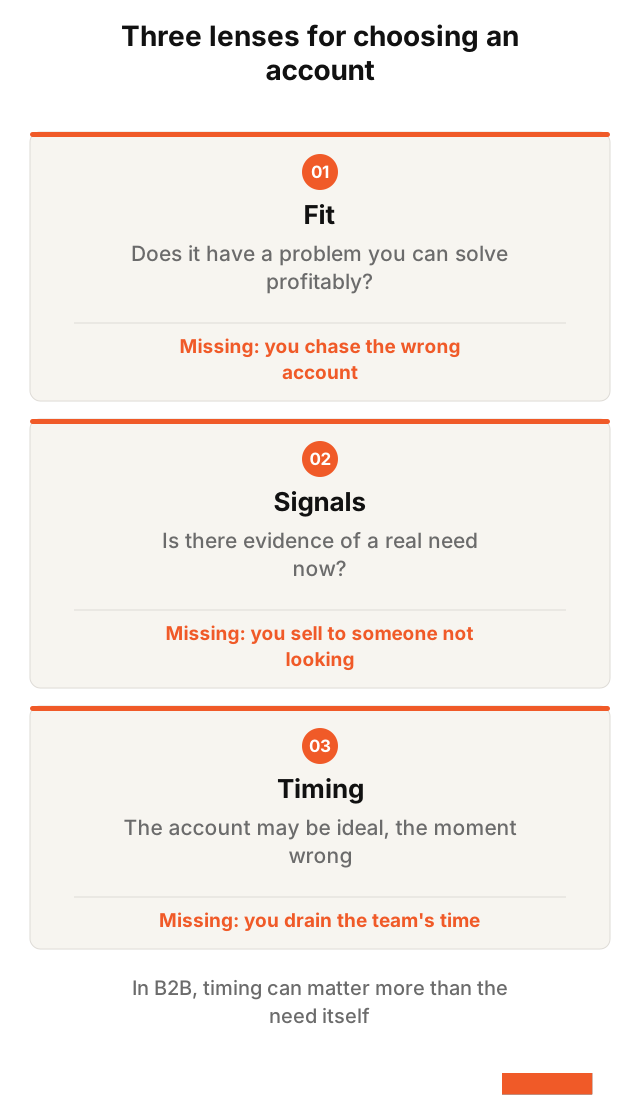
How do you know which account deserves the investment? Three governing lenses:
| Lens | Questions | If it is missing |
|---|---|---|
| Fit | Does it have a problem you can solve? Does it understand the value of the solution? Can it become a profitable client? | You chase the wrong account |
| Signals | Is there evidence of a real need now — new expansion, funding, new leadership, a tender or a strategic initiative? | You sell to someone who is not looking |
| Timing | The account may be ideal and the problem real, but the moment wrong | You drain the team’s time |
The third lens is the most neglected. In B2B, timing can matter more than the need itself, because a real need without an allocated budget or an open buying cycle does not convert, however genuine it is.
The practical difference between the lenses: fit is a relatively stable attribute; signals and timing are variables. A qualified account list is therefore not a document written once, but a state reviewed periodically.
When Deep Tailoring Is Right, and When It Is Not
There is a common misreading of account-based targeting: that it means chasing big names, or a wish list of clients you dream of working with.
At its core the approach is deep tailoring for an account that warrants that tailoring. And an account does not warrant it because it is large. It warrants it when two conditions hold together: a clear need, and a genuine chance of winning.
Before that stage you do not need full tailoring. You need relevant content, deeper research, relationship building and sustained engagement — activities that are far cheaper and better suited to the stage.
The most expensive error is applying it too early: substantial resources are consumed on accounts that have not yet reached the buying stage, and the budget runs out before the opportunity matures.
The clearest rule I know: deep tailoring begins when the opportunity matures, not when the client’s name shines.
Case One: The Cost of Broad Targeting
The ambition
General Electric was no ordinary company. It was among the largest industrial names in the world — aircraft engines, power turbines, medical devices, locomotives, and equipment that cannot afford to stop.
In 2013, then-CEO Jeff Immelt announced a new vision: the shift from an industrial company to a digital industrial company. In 2015 the company launched Predix, a cloud platform for industrial data and analytics.
The declared targeting was as broad as the ambition: multiple industrial sectors at once, an aspiration for the platform to become to the industrial internet what the operating system had been to the personal computer, and a stated goal of fifteen billion dollars in digital revenue by 2020.
On paper everything was convincing: a giant company, a vast market, a real problem, an ambitious goal.
What was funded
Under Immelt the company spent more than four billion dollars on the transformation across six years, and built a private cloud infrastructure to compete with the major cloud providers.
What execution revealed
In spring 2017 the company called a two-month internal time-out to tackle the platform’s problems. The review found that the platform was trying to be everything to everyone — on an outdated technology stack, with an unclear business model.
The correction came in the exact language of targeting: the company directed its resources toward selling to existing customers in power, aviation and oil and gas, and scaled back efforts to sell to new customers in other sectors. As the head of the digital unit put it at the time, resources would go to the fastest-selling markets.
The price
| Date | What happened |
|---|---|
| November 2017 | Digital unit costs cut by four hundred million dollars, aiming to double platform revenue to one billion |
| December 2018 | Announcement of the digital unit’s separation, starting with about 1.2 billion dollars in annual software revenue |
| November 2021 | Plan announced to separate the group into three independent companies |
| January 2023 | Separation of the healthcare arm completed |
| April 2024 | Break-up completed with the launch of the energy and aerospace companies |
Note what the 2018 goal implies: doubling revenue to reach one billion means actual revenue stood at roughly half that — against a declared target of fifteen billion by 2020.
And when the digital unit was separated, most of its software revenue came from legacy products that predated the new platform itself.
The commercial lesson: the idea did not fail because it was weak. It failed because it tried to be everything to every sector. The internal review diagnosed exactly that, and the remedy was to narrow the targeting — after billions had been spent.
Case Two: The Return on Narrow Targeting
The starting point
Tide, a digital financial platform, was founded in 2015 and launched in the United Kingdom in 2017 to serve small businesses. Official statistics from the UK Department for Business and Trade put that community at about 5.5 million businesses, of which more than ninety-nine per cent are small.
The question it started from was not “how do we sell more financial services?” but a fundamentally different one: how do we reduce the time a business owner wastes on financial administration?
Where it chose to focus
After several moderately successful acquisition campaigns that relied on assumptive selections and generic solutions targeting diverse businesses, the company and its data partner ran a post-campaign analysis.
The analysis revealed one clear pattern: a standout response rate from businesses that had just reached their first-year anniversary.
The logic behind the pattern is commercial, not statistical: a business that has completed its first year has passed the survival stage and begins facing different challenges — cash-flow management, expense control, organising financial operations, and searching for more efficient tools to grow.
At exactly that point the need turns from latent to visible, and the owner becomes ready to make a decision.
So the company did not target all small businesses. It targeted the segment most ready to respond — at precisely the moment of its readiness.
The result
A direct mail campaign was launched for that segment alone, to a list of thirty thousand business owners approaching the milestone. Print mail was chosen because industry research showed it prompted around a third of recipients to take a commercial action, at a rate exceeding email.
| Metric | Result |
|---|---|
| Response rate | Five times expectations |
| Cost per acquisition | Down 78% |
| Cost versus industry benchmark | 25% lower |
| Net promoter score | Up 6% |
And the results did not stop at the campaign. The focus on the same segment continued, and the market-share trajectory shows the cumulative effect:
| Year | UK members | Market share |
|---|---|---|
| 2021 | About 400,000 | 7% |
| 2023 | 550,000 | 10% |
| 2025 | 750,000 | 13% |
| 2026 | About 900,000 | About 15% |
Total membership passed two million globally, with parallel growth in the Indian market.
The commercial lesson: growth did not come from reaching more, but from reaching the most ready at the right time. The choice that looked small — a segment within a segment, defined by a moment in time — was the turning point.
Tools and AI: What Can Be Automated, and What Cannot
The targeting landscape has genuinely changed in recent years. It is now possible to discover accounts matching a profile automatically, track leadership and funding changes inside companies, and read buying-intent signals before the buyer contacts anyone.
Artificial intelligence added another layer: building tailored messages at scale, scoring every account automatically, enriching data, and building intelligent follow-up workflows.
The essential shift: a few years ago we tried to work out who might buy. Today it is possible to know who is preparing to buy.
But one decision remains that cannot be automated: which client deserves the investment?
Tools rank, classify and predict, but they operate inside criteria a human sets. And whoever sets the criteria determines who the business serves and who it refuses. That is a leadership decision, not a technical one, and automating it is an illusion — the tool will simply execute your wrong criteria more efficiently.
The Practical Test
This week, gather the three files we began with, then draw three intersecting circles:
- The declared targeting circle — who do you say you target?
- The funded targeting circle — where did the money and effort actually go?
- The executed targeting circle — who actually bought from you?
Then ask, for each segment inside the target list:
- How many accounts sit inside the ideal customer profile?
- Do we know the buyers by name?
- How many of them know you? How many are interested?
- How many are talking to the sales team?
- How many chose a provider in the last twelve months?
Reading the result is simple: what appears in all three circles is your real concentration. What appears in one circle only is a gap that is draining you.
The list nobody usually writes
Finally, write one more list: who will we not serve right now?
This list is no less important than the strategy itself, because it is the only instrument that protects the company’s focus in practice. The strategy says what we do; this says what we refuse — and without the second, the first degrades into intent.
If you cannot answer it with names and numbers, you are not yet running a targeting programme.
Conclusion
A business that tries to target everyone pays twice: once in resources drained, and once in focus lost. A business that narrows its targeting deliberately grows faster at lower cost — not because it works harder, but because it works in the right place at the right moment.
The question is not about General Electric, and not about Tide. The question is about your own business:
Today you have three targetings — one you write, one you fund, and one that actually buys. If they differ, you are not running one market. You are running three businesses at once.
Sources
All links below were accessed on 23 September 2026. Sources are ordered strongest first: official government statistics, then company and regulatory filings, then reported journalism.
Official statistics
UK Department for Business and Trade — Business population estimates for the UK and regions, official statistical release.
https://gov.uk/
Documents: 5.5 million private sector businesses in the UK, of which 5.45 million are small businesses with fewer than fifty employees.
House of Commons Library — Business statistics research briefing, December 2025.
https://commonslibrary.parliament.uk/
Documents: 5.7 million businesses at the start of 2025, of which 99.9% are small and medium-sized enterprises.
Company and regulatory filings
General Electric — official press release: board approves the spin-off of the energy arm, 29 February 2024.
https://www.ge.com/
Documents: completion of the transformation into three independent companies with both launching on 2 April 2024.
US Securities and Exchange Commission — registration filing for the energy arm’s separation.
https://www.sec.gov/
Documents: the separation plan announced on 9 November 2021, and completion of the healthcare arm’s spin-off on 3 January 2023.
Tide — “Tide now supports over 1.5 million small businesses globally”, 29 July 2025.
https://www.tide.co/
Documents: 1.5 million members globally, 750,000 UK members at 13% market share, and the company’s founding in 2015 and launch in 2017.
Tide via Businesswire — “1 in 10 UK Small and Mid-Sized Businesses on Tide”, 19 September 2023.
https://www.businesswire.com/
Documents: 550,000 members at 10% market share.
Documented case study
Marketreach — the research arm of Royal Mail — Tide campaign case study.
https://www.marketreach.co.uk/
Documents: targeting businesses at their first-year anniversary, the list of thirty thousand owners, a response rate five times expectations, a 78% reduction in cost per acquisition, 25% below the industry benchmark, and a 6% increase in net promoter score.
Reported journalism
Reuters via Fox Business — “GE shifts strategy, financial targets for digital business after missteps”.
https://www.foxbusiness.com/
Documents: more than four billion dollars spent across six years, the two-month time-out in spring 2017, and the decision to focus on existing customers in energy, aviation and oil and gas while scaling back other sectors.
CIO Dive — “GE to scale back Predix amid companywide restructure”.
https://www.ciodive.com/
Documents: the four hundred million dollar cost reduction and the fifteen billion by 2020 target.
IndustryWeek — “GE Predix Platform’s Focus Narrows as Flannery Cuts Digital Spending”.
https://www.industryweek.com/
Documents: the goal of doubling platform revenue to one billion dollars.
SDxCentral — “GE Spins Off Its Digital Business, Including Predix, Into a Separate Company”.
https://www.sdxcentral.com/
Documents: the December 2018 announcement and about 1.2 billion dollars in annual software revenue at separation.
IT Brief UK — “Tide launches business investment account for SMEs”.
https://itbrief.co.uk/
Documents: about 900,000 UK members at roughly 15% share, and more than 1.1 million in India, in 2026.
Augmentum Fintech — “Tide welcomes a 7% market share of the UK SME banking market”.
https://augmentum.vc/
Documents: about 400,000 members and a 7% share in 2021.